Brief guide to the selection of a typical plate heat exchanger
The selection of a plate heat exchanger has to take a lot of factors into consideration. Things like:
The thermal exchange between two fluids and the active surface of the heat exchanger are very important but they are not the only significant factor. The thermal length, theta angle and the logarithmic temperature difference of the fluids are just some of the factors we need to consider when calculating a heat exchanger.
The fluid dynamics of the heat exchanger for the selected fluids. The viscosity of each fluid and how homogeneous it is can have a direct impact on the fluid flow. The internal set-up of the heat exchanger can impact the flow speed and pressure drop, the pump flow capacity and internal flow distribution. Internal blockage and cavitation are some of the usual effects on the heat exchanger.
The mechanical strength of the heat exchanger depends on the pressure limits and the temperature limits required by the operating fluids. Different materials and manufacturing methods provide different limits. A wrong or inadequate selection can have destructive consequences on the heat exchanger integrity.
The aggressiveness of the environment or the fluids can cause a corrosion and ultimately the failure of the heat exchanger. Corrosion failure can happen in very small time frames even within a few weeks or a few days provided the materials are inadequate for the required use.
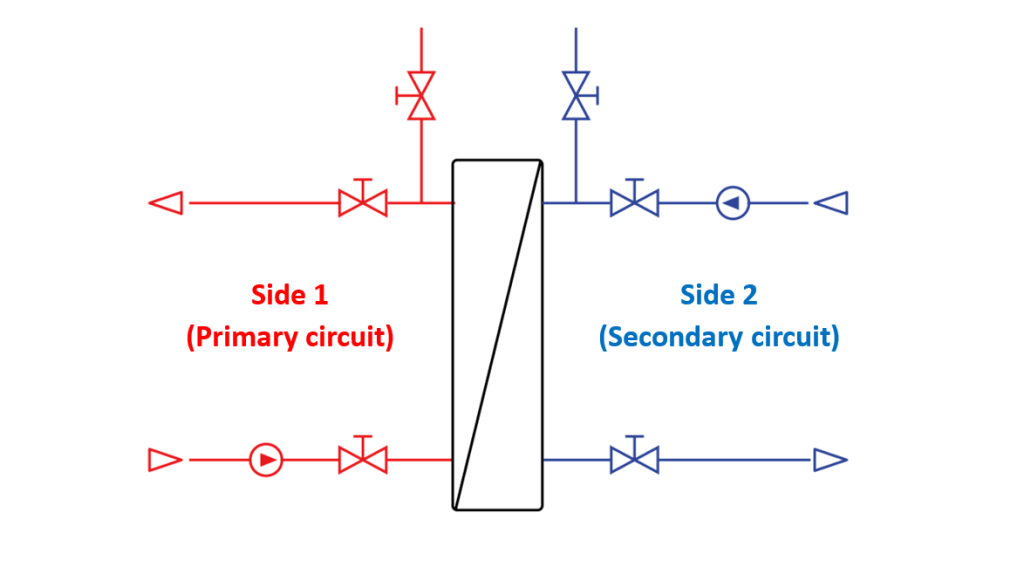
A typical plate heat exchanger has 2 sides/circuits, the side of the primary fluid and the side of the secondary fluid. The fluids the flow through these sides can be the same or can be different. To cater for a proper selection, we need to know at least the following:
The two fluids that will be used in the heat exchanger
Each fluid state upon inlet and outlet, that is if they will be changing state to gas or vice-versa or not.
At least 5 from the 7 below:
Inlet temperature of fluid 1
Outlet temperature of fluid 1
Fluid 1 flow
Inlet temperature of fluid 2
Outlet temperature of fluid 2
Fluid 2 flow
Thermal capacity
Let us assume the following example:
Side 1: Water with corrosion resistance and freeze protection additives in a closed loop coming from solar heaters. The average heat exchanger inlet temperature is 80oC and the required outlet temperature is 70οC.
Side 2: Fresh water (quality is «fresh water quality» from average city main supply) with average inlet temperature of 20oC and required outlet temperature of 60oC.
We do not know the exact fluid flows due to a large pipe network but we know that the nominal thermal capacity of the solar heaters is 15kW.
Our target is to continuously provide fresh hot water in a buffer tank. Of course, we know that there will be no phase change on either side of the heat exchanger and both sides will remain at their fluid state all the time.
We the above assumptions it is possible to successfully calculate a plate heat exchanger that will cover our needs and last for a very long time.